THE FIRST GREAT PLATONIST
Aristotle tries to correct what he sees as Plato's mistakes
Plato, 427-347 BCE. Aristotle, 384-322 BCE.
Raphael Sanzio da Urbino (1483-1520), The School of Athens
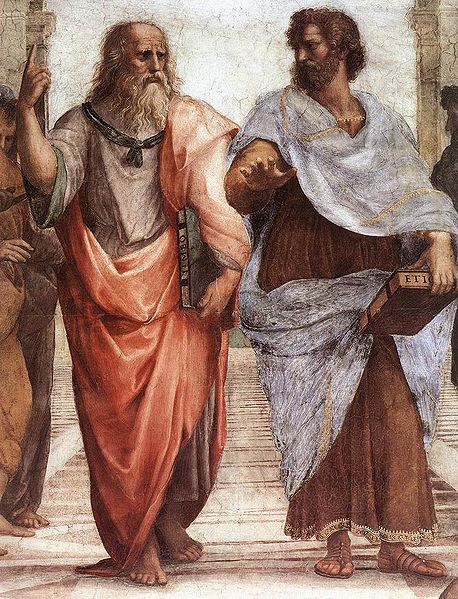
Plato points to a "higher" reality. Aristotle points forward.
He accepts what he regards as the central parts of Platonism, but he
also is a critic who eliminates its
excesses.
Plato holds a copy of the Timaeus, a late dialogue devoted to cosmology.
Aristotle holds a copy of a work in ethics.
The titles TIMEO and
ETICA on these books translate from Italian into English as TIMAEUS and ETHICS.
Aristotle belongs to the Period of Schools.
He entered Plato's Academy in 367 BCE when he was seventeen and remained
until Plato's death in 347 BCE.
In 335 BCE, Aristotle founded his school in the Lyceum (a gymnasium located outside and east of Athens's city wall).
The Aristotelian Corpus
As we now have it, the works in the Aristotelian corpus are esoteric and have been organized systematically into roughly three subjects. As esoteric works, they are lectures Aristotle writes for members of his school. The logical works are first, the physical works are next, and the ethical works are last. The original chronological ordering of these works is not easy to see.
This makes the Aristotelian corpus a little different from the Platonic corpus.
In Plato's dialogues, we can see the development of various lines of thought in his reaction to Socrates. This does not give us a complete chronological ordering, but it does help us see a rough ordering of the dialogues in the corpus into early, middle, and late dialogues.
Although some of the conversations in Plato's dialogues are more challenging than those in everyday life, in general they are not difficult for outsiders to read. Plato models his early dialogues on conversations Socrates had, and these conversations were not with philosophers.
It adds too to their difficulty that the works in Aristotle's corpus are lectures on technical parts of philosophy he writes in expository prose and that mostly are much less finished than Plato's dialogues. Some of Aristotle's writing is easy enough to follow, but the majority is not.
Platonist and Plato's Critic
These differences can make Aristotle hard to understand, but our general strategy will be the same one we used to understand Plato. Socrates was Plato's greatest influence. Plato is Aristotle's. Aristotle spent twenty years in Plato's Academy. Just as we assumed Plato was trying to understand what was right and to correct what was wrong in what Socrates thought, we are going to work through the Aristotelian corpus in roughly its systematic ordering on the assumption that Aristotle is trying to understand what was right and to correct what was wrong in what he learned from Plato during his time as a student in the Academy.
One place we can see Aristotle doing this is in his physical works.
The physical works form the largest part of Aristotle's corpus. These works, as they have been handed down to us, are organized systematically. They Physics is first. It is
an inquiry into the truths that hold throughout nature. Subsequent works in the
physical works are discussions of specific parts of nature. On the Soul,
for example, which we will consider in a later lecture,
is the first work in the physical works about the nature of "ensouled" and hence
living beings.
ἔμψυχος means alive.
It is formed from ψυχή ("soul") and the prefix ἐν ("in").
Aristotle, with his deep interest in nature, is following Plato against Socrates.
Plato disagreed with Socrates about whether knowledge of nature and of reality generally is part of wisdom. Whereas Socrates thought that all we need to know is what is good and what is bad, Plato thought that the soul forgets itself when it descends into the body and that the best life a soul can live in the body is one of managing its time so that as much as possible it recovers the knowledge of reality of things it once possessed when it was apart from the body.
Plato tries to describe this reality in the Timaeus. This traditionally is a late dialogue. Plato wrote it late in his life and after Aristotle had become a member of the Academy.
Timaeus, not Socrates, leads the discussion.
He is the
"best astronomer and has made it his special task to know about the nature of the whole"
(27a).
He begins with "the origin of the cosmos" and ends "with the
generation of man."
In this discussion, he explains the existence of sensible things
Timaeus describes sensible things as the "offspring" of the forms
and the receptacle
(Timaeus 50d).
He supposes that before the god created the cosmos,
the traditional elements (fire, water, earth and air) were
"without reason and measure"
(Timaeus 53a),
that the god formed them to "be as beautiful and excellent as possible"
(Timaeus 53b),
and that he constructed the rest of the cosmos from them.
"For at that time [before the demiurge did his work] nothing had a share in these proportions save by chance, and there
was nothing at all worthy of being called by the names we now use, such as fire or water or any of
the others. Rather he first set all of these in order, then constructed this universe from them; a
single living being containing within itself all living beings both mortal and immortal. He himself
was indeed the artificer of the divine beings and he commanded his own offspring to undertake
the creation of the mortals.
And they, imitating their father, received the immortal beginning of soul, then fashioned a mortal
body in a globe around it, for it, and bestowed the entire body as its vehicle and also built on
another form of soul in the body: the mortal form"
(Timaeus 69b),
in terms of
forms
(27d),
the divine maker ("artificer" or "demiurge" (δημιουργός)) who is supremely good and
brings a cosmos into existence as like himself as possible
(30a),
and
the "receptacle" (ὑποδοχή)
that becomes like the forms (49a).
We can begin to understand Aristotle's approach and contribution to philosophy if we understand him as trying to remove the problems he sees in this picture of reality in the Timaeus. Aristotle accepts, as we will see, that there is teleology in nature but rejects that things are the way the are because of the actions of a divine maker. He understands the existence of sensible things in terms of forms but does not think these forms exist as Timaeus describes them. Instead of the existence of the receptacle, Aristotle has what he calls matter.
Existence in the World of Natures
Aristotle talks about forms in his description of the kind of existence
he takes what he calls "substances" (οὐσίαι) to possess. We will work to to understand Aristotle's conception of substances and their existence
over the next several lectures, but
the initial idea is that
The noun οὐσία is from a participle of the verb εἶναι ("to be") and a noun-forming suffix -ία.
For οὐσία, Latin gives us the translation as essence. Translators invented the participle essens (of the verb esse, "to be))
so they could form the word
essentia
in imitation of the derivation of οὐσία in Greek.
Seneca, in his Epistles 58.6,
translates οὐσία this way and cites the authority of Cicero to justify the use of essentia as a Latin word.
The more standard translation, however, is substance. This translation follows the Latin
substantia = sub ("under") + stare ("to stand"),
and, as we will see, it is the more natural way to capture Aristotle's understanding of substance.
substantia = ὑπόστασις = ὑπό + στάσις.
• human beings and other sensible substances have natures
• their natures are organizations of their matter
• these organizations are the forms of sensible substances
This initial idea is plenty obscure, but it does allow us to begin to see why Aristotle's logical works are traditionally first and the physical works are second in his corpus.
Demonstrations in Physics
"demonstration" (ἀπόδειξις)
The logical works
build to an explanation of what Aristotle understands as the grasp of reality we achieve when we have the kind of
understanding he calls
a demonstration.
In the logical works, the Categories is first. It discusses terms, the parts of sentences. On Interpretation is second. It discusses sentences, the parts of deductive arguments. The Prior and Posterior Analytics are next. The Prior Analytics discusses deductive arguments, and the Posterior Analytics discusses the subset of these arguments that are demonstrations.
Definitions for Aristotle express what he describes as "the what it is to be."
"the what it is to be" (τὸ τί ἦν εἶναι)
For the imperfect in τὸ τί ἦν εἶναι, see
Smyth 1901-1902
and "F" in the entry for
εἰμί in Liddell and Scott.
In the case of sensible substances, this definition specifies the form in matter.
Demonstrations that specify the form in matter as their major premise are deductive arguments
we grasp when we know
why these substances have the behaviors they possess as members of
a natural kind.
"A deduction (συλλογισμός) is an argument in which, certain things having been
supposed, something different from those supposed results of necessity because
of their being so"
(Prior Analytics I.1.24b).
"The reason why we must deal with deduction before we deal with demonstration is that deduction is more universal; for demonstration (ἀπόδειξις)
is a kind of deduction, but not every deduction is a demonstration"
(Prior Analytics I.4.25b).
"The starting-point of every demonstration is the what it is (τὸ τί ἐστιν)"
(On the Soul I.403a).
In a syllogism, there are three terms: "subject" (S), "middle"
(M), and "predicate" (P). Each premise has one term in
common with the terms in the conclusion. In the major premise, the predicate
is the common term. In the minor premise, the subject is the common term.
It is customary to write the major premise first. This can seem unnatural
until one realizes Aristotle does not write "All M are P."
Instead, he writes "P is predicated of all M." So when the premises and
the conclusion are expressed in the form Aristotle uses, the demonstration
All M are P
All S are M
----
All S are P
takes the form
P is predicated of all M
M is predicated of all S
----
P is predicated of all S
"For if A is predicated of all B, and B of all
C, A must necessarily be predicated of all C"
(Prior Analytics I.4.25b).
Aristotle's theory of the syllogism is a major achievement in logic that was only surpassed
in the last hundred years or so.
Aristotle takes human beings to be sensible substances, and we can imagine how they would appear
in a demonstration.
Aristotle does not give the definition, as his works are exploratory, but
we can suppose for an example that to be a human
being is to be a rational animal.
This definition gives us "the what it is to be." In the demonstration we are constructing, it appears as the major premise. It tells us that humans are beings whose matter is in the organization and form of a rational animal, and the minor premise tells us that part of being a rational animal is possessing the power to use sensations to have beliefs.
Rational animals can use their sensation to have beliefs.
(All M are P)
Human beings are rational animals.
(All S are M)
----
Human beings can use their sensations to have beliefs.
(All S are P)
Aristotle's idea is that this demonstration shows us some of the structure that characterizes human existence. Human beings are each matter in the form of a rational animal. This is the reality and "what it is to be" human, and it is a consequence of this organization of matter that individual human beings possess the power to have beliefs in terms of their sensations.
The Life of a Philosopher
This example demonstration helps us see why Aristotle thinks of physics as philosophy.
Plato, in the Phaedo, as we saw, makes Socrates describe the φιλόσοφος as someone who devotes his life to possessing knowledge of forms. These forms he describes as the unchanging, invisible reality of things we grasp not through the senses but in the exercise of reason.
"Is the
reality itself (αὐτὴ ἡ οὐσία), whose reality we give an account in our
dialectic process of question and answer, always the same or is it liable to
change? Does the equal itself, the beautiful itself, what each thing itself is, the reality, ever
admit of any change whatsoever? Or does what each of them is, being uniform and existing
by itself, remain the same and never in any way admit of any change?
It must necessarily remain the same, Socrates.
But how about the many things, for example, men, or horses, or cloaks, or any other such
things, which bear the same names as those objects and are called beautiful or
equal or the like? Are they always the same? Or are they, in direct opposition to those others,
constantly changing in themselves, unlike each other, and, so to speak, never the same?
The latter, they are never the same.
And you can see these and touch them and perceive them by the other senses,
whereas the things which are always the same can be grasped only by the reasoning of the intellect (τῷ τῆς διανοίας λογισμῷ),
and are invisible and not to be seen?
Certainly that is true.
Now, shall we assume two kinds of existences, one visible, the other invisible?
Let us assume them, Socrates"
(Phaedo 78c).
Aristotle applies this idea to sensible substances. He thinks that these substances have an unchanging reality, that this reality is the form in the matter, that we know this form in reason, and that this knowledge is the basis for the account we give in demonstrations.
This shows of some of why Aristotle thinks of physics as philosophy, but
δευτέρα φιλοσοφία, "second philosophy"
The noun φιλοσοφία more literally means "love of wisdom." This is how we translated
Socrates when Plato made him say he would not abandon φιλοσοφία. Aristotle
works in this same tradition, but we are familiar enough with
this tradition now to use the conventional translation.
πρώτη φιλοσοφία, "first philosophy"
it does not give us the complete picture. Aristotle thinks that physics is philosophy but also that it is what he calls "second philosophy" and thus
that it is second to what he calls "first philosophy."
To understands why physics is second philosophy, we need to take a closer look at how Aristotle understands both sensible substances and the existence of substances more generally. This will take us to Aristotle's discussion of first philosophy in his Metaphysics. This work sits between the physical and the ethical works. We look at it in a later lecture.
Thinking about Aristotle
Aristotle is not easy, but we have a strategy for understanding what he thought.
We are looking to see how he supplies missing details in the thought he knew from his time in Plato's Academy and how he removes what he regards as its mistakes and excesses.
To see how Aristotle does this, we are thinking about his reaction to Plato's account of reality in the Timaeus. In this dialogue, Timaeus explains the existence of living things in the cosmos in terms of forms and the work of a supremely good divine maker. We are trying to understand what part of this account Aristotle accepts and what part he rejects.
Our first step, to which we now turn for more detail, is Aristotle's theory of sensible substances.
Perseus Digital Library
Plato,
Theaetetus,
Timaeus
Aristotle,
Metaphysics
Henry George Liddell, Robert Scott, A Greek-English Lexicon
ἀπόδειξις, apodeixis, noun, "showing forth, making known, exhibiting"
ἐξωτερικός, exōterikos, adjective, "outer"
(a comparative of ἔξω, exō, adverb, "out")
ἐσωτερικός, esōterikos, adjective, "inner" (coined to correspond to ἐξωτερικός)
κόσμος, kosmos, noun, "order"
φιλοσοφία, philosophia, noun, "love of wisdom"
συλλογισμός, noun, "computation, calculation"
Charlton T. Lewis, Charles Short,
A Latin Dictionary
essentia
substantia
Arizona State University Library: Loeb Classical Library:
Aristotle,
Categories,
On Interpretation,
Prior Analytics,
Posterior Analytics,
Physics
"Aristotle wants to hold on to the metaphysical primacy of objects, natural
objects, living objects, human beings. He does not want these to be mere
configurations of more basic entities, such that the real things
turn out to be these more basic entities. But
to look at an object [as Aristotle thinks the inquirers into nature do] just as the configuration of material constituents
transiently happen to enter into is to look at the material constituents as the
more basic entities"
(Michael Frede, "On Aristotle's Conception of the Soul," 146. Essays on Aristotle's De Anima, 93-107).
"Horses are a kind of beings, and camels are a different
kind of beings, but neither horses nor camels have a distinctive way of being,
peculiar to them; they both have the way of being of natural substances..., as
opposed to, e.g., numbers which have the way of magnitudes..."
(Michael Frede, "The Unity of General and Special Metaphysics: Aristotle's Conception of
Metaphysics," 85-86. Essays in Ancient Philosophy, 81-95).
"Aristotle's view of the world is such that the behavior of things in the celestial
spheres is governed by strict regularity dictated by the nature of the things involved.
But once we come to the sublunary, grossly material sphere in which we live, this
regularity begins to give out. It turns into regularity 'for the most part,' explained
by the imperfect realization of natures in gross matter. What is more, these
regularities, dictated by the natures of things, even if they were exceptionless, would
leave many apsects of the world undetermined"
(Michael Frede, A Free Will, 28).